

Beyond Merch: How Brands Are Building Premium Apparel Lines Instead
Most companies approach branded apparel the same way. They open a supplier catalog, pick a blank hoodie, drop a logo on the chest, and order five hundred units. It is fast, it is cheap, and it produces something almost no one would buy if the logo were not on it.
That model is quietly breaking. Over the past two years, car companies, hotel groups, beverage brands, sports properties, creators, and licensing agencies have arrived at the same conclusion independently: the logo is not the product. The product is the product.
This is the shift from merch to premium branded apparel — and it has less to do with spending more than with building something you actually own.
THE MERCH CEILING
Traditional branded merchandise is a decoration business. Someone else designs and manufactures the garment. You rent the last three inches of it.
That arrangement caps three things at once.
It caps quality. You inherit whatever fit, fabric, and construction the blank supplier chose. If the hoodie is boxy and the cotton pills after four washes, that is now your brand's cotton.
It caps differentiation. Your competitor can order the identical blank. The only variable is the artwork, which means you are competing on graphics rather than on product.
It caps margin. Printed blanks are priced against a known commodity. Customers can estimate what the shirt cost, so there is a ceiling on what they will pay for it. The math rarely justifies treating apparel as a real revenue line.
None of this matters if apparel is a giveaway. It matters enormously the moment you want people to choose it, pay for it, and wear it when no one is watching.
WHY THE SHIFT IS HAPPENING NOW
Several forces converged at once.
Consumers stopped grading merch on a curve. PPAI's 2026 consumer study, based on more than 3,400 U.S. respondents, found that people no longer evaluate branded merchandise in isolation — they compare it against products they already buy themselves. As the study puts it, merch is no longer judged as a free item. Only 28% of consumers said branded merch feels mostly premium, while poor quality was the second most common reason items get discarded. Two-thirds said they would rather receive fewer, higher-quality items than more low-cost ones, and nearly 90% agreed that high-quality merch improves how they think about a brand.
Bad apparel is not neutral. It actively costs you.
Budgets are under pressure, which raises the bar. The North American promotional products industry reached a record $27.7 billion in 2025, up 4.2%, according to ASI — but ASI also noted that nearly 90% of distributors raised prices that year to offset tariffs, with increases averaging around 11%. Read together, that means buyers are paying more for the same commodity goods. When the cheap option stops being cheap, the case for making something genuinely better gets much easier to argue internally.
Corporate brands are already a licensing powerhouse. In Licensing International's most recent Global Licensing Survey, worldwide licensed product sales reached $389.8 billion in 2025. Corporate brands — companies whose core business is not entertainment, sports, or fashion — accounted for $98.0 billion of that, a 25.2% share and the second-largest property type overall. Ordinary companies licensing their names into consumer product is not a fringe experiment. It is a quarter of the market.
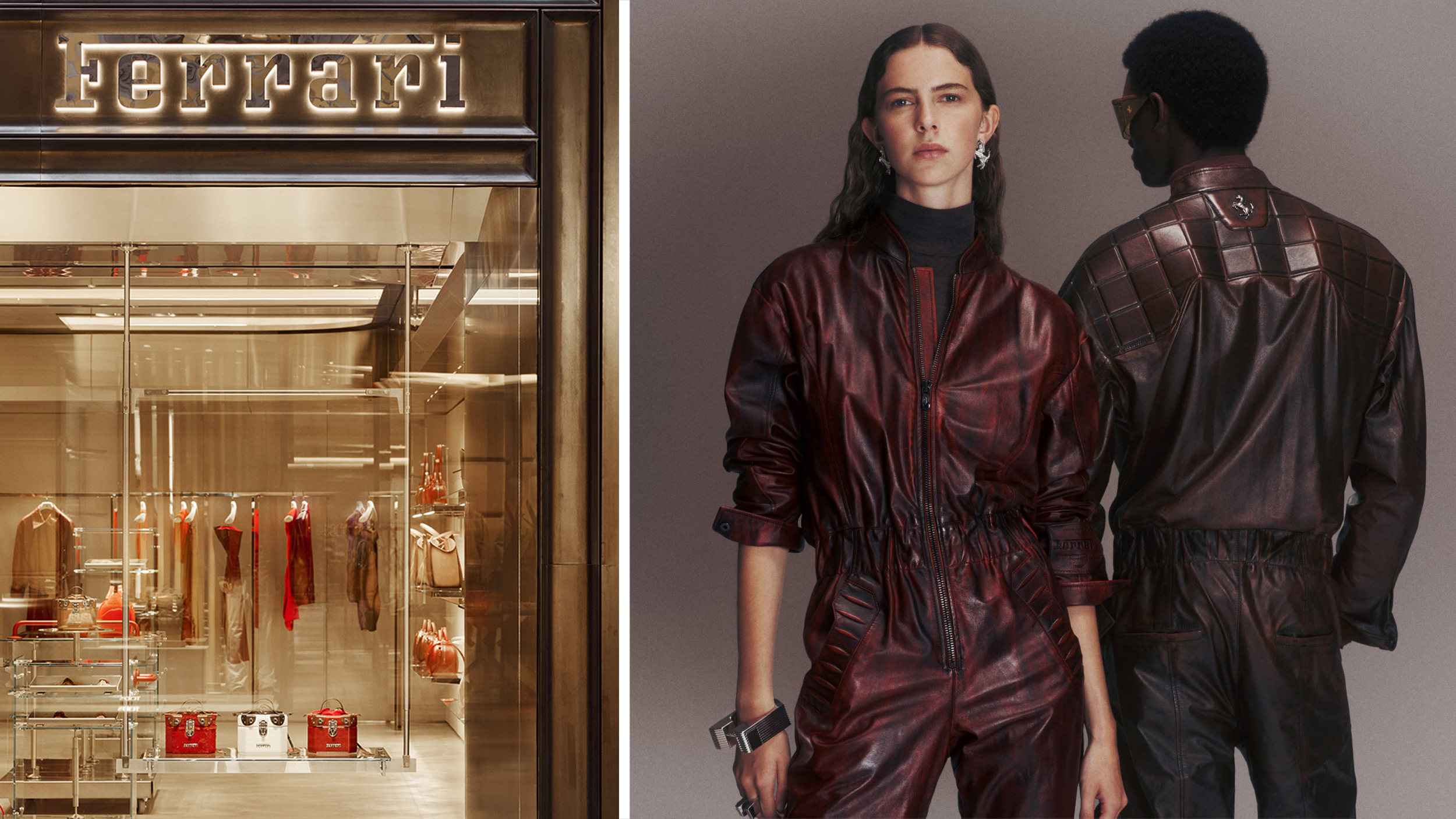
And the proof cases are real. Ferrari, a car company, now shows ready-to-wear on the Milan Fashion Week calendar — ten collections and counting, reviewed by the fashion press as fashion rather than as car merch, and sold at fashion prices. Aman, a hotel group, built The Essentials into a full ready-to-wear line designed and made in Italy and sold through its own boutiques, with pieces reaching into the thousands of dollars.
Neither of those is a collaboration, and that distinction is the whole point. A co-branded capsule rents another company's product expertise, splits the margin, and ends when the drop ends. A brand-owned line means the fit, the fabric, the patterns, the pricing, and the right to sell it again next season all belong to you.
What that takes is apparel expertise. What it does not take is building that expertise permanently in-house — which is where most brands talk themselves out of the opportunity.
WHAT ACTUALLY SEPARATES MERCH FROM FASHION
The industry term is cut-and-sew, which simply means the garment is built from scratch to your specification rather than bought finished and printed.
In practice, the difference is control over every variable that makes clothing good:
Silhouette and fit. You decide the shoulder, the body length, the sleeve, the drape. This is the single biggest reason custom garments feel different on the body.
Fabric. Weight, hand feel, composition, performance, and sustainability claims become choices instead of defaults.
Construction. Seam finishes, linings, hardware, pockets, and reinforcement — the details that separate a $28 garment from a $128 one.
Trims and branding. Woven labels, custom hardware, embroidery, and packaging that make the brand present without a chest logo doing all the work.
Ownership. A custom garment is intellectual property. A printed blank is someone else's product with your art on it. Only one of those is an asset you can license, extend, protect, and build a category around.
THE MARGIN ARGUMENT
This is usually the part that decides it internally.
A printed blank carries a low development cost and a low ceiling. A well-developed custom garment costs more to make and more to develop, but it competes against retail apparel rather than against promotional goods — which is a completely different pricing environment. Brands that make the jump typically find that the higher development investment is recovered across the first production run, and that every run after that is pure upside.
Just as important, custom product changes what apparel is on the P&L. Merch is a marketing expense. A branded apparel line is a revenue stream with its own margin profile, repeat purchase behavior, and licensing potential.
WHAT IT ACTUALLY TAKES
Here is where most in-house teams stall, and it is not a failure of ambition. It is a genuinely specialized discipline.
Developing a custom apparel line requires creative direction and a product strategy, then technical design — the tech pack that tells a factory exactly how to build the garment. It requires fabric sourcing and trim development, pattern making, grading a size range that fits real bodies, sampling and fit sessions across multiple rounds, factory identification and vetting, cost engineering to hit your target margin, production management, and quality control across the full run.
It also requires knowing the constraints before you design against them: minimum order quantities that vary by fabric and factory, development timelines that typically run several months rather than several weeks, and the reality that the first sample is never the last one.
A marketing team can brief this work brilliantly. Very few can execute it, because none of it is marketing. It is apparel product development.
WHO IS MAKING THIS MOVE
The inquiries we field now cluster into three groups.
Corporations with strong brand equity. Automotive, hospitality, food and beverage, tech, and sports properties that have realized their audience would wear their brand if the product were worth wearing. Many start with an employee or corporate apparel program and discover a consumer business inside it.
Creators and talent. Influencers who have outgrown print-on-demand and want a real clothing line with proprietary product, better margins, and something that survives past a single drop. This is the difference between merch and a brand, and audiences can tell instantly.
Licensing agencies and IP holders. Groups sitting on entertainment, character, heritage, or personality IP who want apparel programs that command premium price points rather than commodity royalties.
Different starting points, same request: make this real.
YOU DON’T NEED AN IN-HOUSE APPAREL TEAM. YOU NEED TO OUTSOURCE.
The honest obstacle for most of these brands is headcount. Building an internal apparel function means hiring a designer, a technical designer, a sourcing lead, and a production manager — a permanent team for what may be a seasonal or annual program.
The alternative is an outsourced apparel team: a partner who plugs into your brand, owns design through delivery, and hands you a finished product and a repeatable process. You keep the brand decisions. They carry the technical and manufacturing load.
THE BOTTOM LINE
Merch made sense when apparel was a giveaway. It stops making sense the moment apparel becomes a brand expression, a revenue line, or an asset you want to own.
The brands winning this shift are not spending recklessly. They are treating apparel like a product category instead of a print job, and they are borrowing the expertise rather than building it.
Interested in Building a Premium Branded Apparel Line?
Stateless works as the outsourced apparel team for brands, creators, and licensing partners who want to move past merch — handling design, development, sourcing, and production management end to end. If you're exploring what your brand could become in apparel, we'd love to talk.